
Maximising Efficiency with Solar Battery Installation in Hertfordshire (2026)

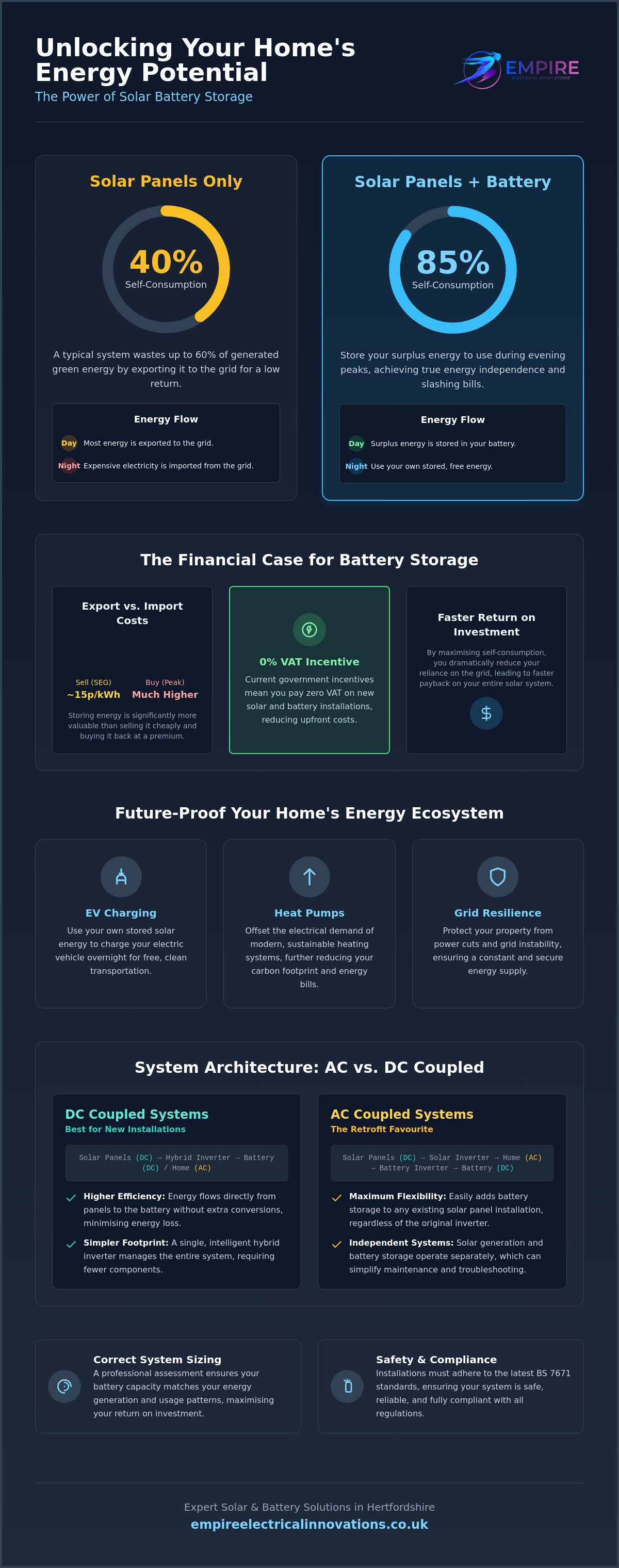
Did you know that a typical solar system without storage only achieves a 40% self-consumption rate, leaving most of your green energy to disappear back into the grid? In 2026, relying solely on solar panels means you're likely still paying premium rates for electricity during evening peaks. It's a common frustration for homeowners across the county who feel the pinch of low export tariffs whilst energy costs remain volatile. We understand that you want a system that provides security and tangible financial returns rather than just a lower carbon footprint.
A professional solar battery installation Hertfordshire service delivers more than just storage; it provides a future-ready energy strategy. This upgrade can increase your self-consumption to as much as 85%, slashing your energy bills and providing true energy independence for your home or business. We will examine the latest BS 7671 Amendment 4 safety standards, the current 0% VAT incentives, and the practical steps to sizing a bespoke system that maximises your long-term savings.
Table of Contents
What is Solar Battery Storage and Why is it Essential in 2026?
Solar battery storage is a technical solution designed to capture the surplus electricity generated by your photovoltaic panels. Instead of allowing excess power to flow back to the National Grid, these systems hold it in reserve for when you need it most. In 2026, a home energy storage systems setup is no longer a luxury; it's a strategic necessity for any modern property. Relying on daytime generation alone is an outdated strategy that fails to account for the reality of household energy patterns.
The UK energy market remains volatile. Whilst solar panels produce the most power during the middle of the day, peak domestic demand occurs in the evening. Without a battery, you're forced to buy expensive electricity from the grid just as the sun goes down. A professional solar battery installation Hertfordshire residents can rely on bridges this gap. It provides a buffer against rising costs and ensures your home remains powered by clean, self-generated energy regardless of the time of day.
Recent data indicates the scale of this shift. In 2025, the UK saw a 34% year-on-year growth in home battery storage, with Hertfordshire tracking ahead of the national average. This trend is driven by a desire for true energy independence. By integrating storage, you're not just generating green power; you're controlling it.
The Problem with Exporting Energy
Exporting surplus energy was once the primary way to recoup solar investment costs. However, the financial landscape has changed significantly. Typical Smart Export Guarantee (SEG) rates in 2026 often sit between 12p and 15p per kWh. When you contrast this with the much higher cost of importing electricity during peak evening hours, the logic of exporting disappears. It's far more cost-effective to keep your energy than it is to sell it and buy it back later. This focus on self-consumption is the most reliable way to achieve a faster return on your investment.
Future-Proofing Your Hertfordshire Home
A modern electrical installation must be future-ready. As we move away from fossil fuels, our homes are becoming increasingly electrified. Battery storage provides the foundation for this transition, allowing for seamless integration with other green technologies.
EV Charging: Use stored solar energy to charge your vehicle overnight.
Heat Pumps: Offset the electrical demand of sustainable heating systems.
Grid Resilience: Protect your property against potential power cuts or grid instability.
Choosing a solar battery installation Hertfordshire specialist ensures your system is designed with these long-term goals in mind. Solar battery storage is a critical component of a sustainable energy ecosystem.
The Technical Mechanics: AC vs DC Coupled Systems
Understanding the science behind energy storage is vital for a successful solar battery installation Hertfordshire project. At its core, the process involves managing the flow of Direct Current (DC) produced by your panels and converting it into the Alternating Current (AC) used by your household appliances. The efficiency of this transition depends heavily on the system architecture you choose. High-performance systems typically aim for a round-trip efficiency of 90% or higher, ensuring minimal energy loss during the charge and discharge cycles.
The inverter acts as the central intelligence of your installation. It dictates how much power can be drawn at once and how quickly your battery can replenish its reserves. Matching battery capacity with solar output requires precision. If your battery is too small, you'll waste surplus energy; if it's too large, you'll never reach full capacity, extending your payback period. Our team focuses on bespoke designs that align with your specific consumption patterns.
DC Coupled Systems: Best for New Installations
DC coupled systems are the standard for new solar PV projects. In this configuration, the solar panels and the battery storage share a single "hybrid" inverter. The energy travels directly from the panels to the battery without being converted to AC first. This streamlined path reduces conversion losses, resulting in superior efficiency. While these systems are technically elegant, they are often more complex to integrate into an existing solar array. For those starting their green energy journey from scratch, DC coupling offers a robust, future-ready foundation. It simplifies the electrical footprint and often reduces the total number of components required.
AC Coupled Systems: The Retrofit Favourite
If you already have solar panels installed, AC coupling is likely your best route. This setup uses a separate storage inverter, allowing the battery to sit alongside your existing equipment without needing to replace your current solar inverter. It's a flexible solution that works with almost any brand of PV system. One major advantage of AC coupling is the ability to "top up" from the grid. By timing your charging for off-peak hours, you can store cheap electricity to use during expensive peak times. This strategy works in tandem with the Smart Export Guarantee (SEG) to ensure you're always using the most cost-effective power source available.
Selecting the right architecture is a technical decision that impacts your long-term savings. For homeowners considering a solar battery installation Hertfordshire, we recommend a bespoke solar and battery design to ensure peak performance from day one.
The Financial Case: ROI and the Smart Export Guarantee (SEG)
Investing in a solar battery installation Hertfordshire is a calculated financial move. In 2026, the return on investment (ROI) is no longer solely dependent on the initial cost of the hardware. Instead, it's driven by your ability to avoid high-cost "Time of Use" tariffs. By utilising "peak shaving," you can draw from your stored reserves during the expensive 4 pm to 7 pm window, effectively bypassing the highest grid prices. This strategy, combined with the 0% VAT incentive available until March 2027, has significantly shortened the typical payback period for local homeowners.
The South East property market also reflects this shift. Modern buyers in Hertfordshire increasingly prioritise energy efficiency and "future-ready" infrastructure. A high-specification battery system acts as a tangible asset that can enhance property value, distinguishing your home in a competitive market. It transforms a standard solar array into a sophisticated energy management hub that offers long-term security against grid price volatility.
Maximising the Smart Export Guarantee
While self-consumption is the primary goal, the Smart Export Guarantee (SEG) provides a secondary revenue stream. As of July 2026, typical SEG rates for existing customers range from 12p to 15p per kWh, though some specialised tariffs offer up to 25p. To maximise this, your system must be integrated with a smart meter to track energy flow with precision. A professional solar panel installation in Hertfordshire serves as the necessary foundation for these savings, ensuring your generation capacity matches your storage potential for the best possible financial outcome.
Longevity and Warranty Considerations
When assessing long-term value, the Energy Saving Trust guide to battery storage emphasises the importance of cycle life. This refers to how many times a battery can be charged and discharged before its capacity begins to degrade. High-performance brands like GivEnergy now offer 10-year guarantees, providing peace of mind for a decade of operation. It's essential to understand the difference between "total capacity" and "usable capacity." A specialist will ensure your solar battery installation Hertfordshire is designed to protect the unit from over-discharging, which preserves the "usable" energy levels and extends the overall life of the cells. This methodical approach to system design ensures your investment remains productive for years to come.
Planning Your Hertfordshire Installation: Sizing and Safety
Precision planning is the hallmark of a successful solar battery installation Hertfordshire. Sizing your system isn't a matter of guesswork; it requires a methodical analysis of your annual electricity consumption and your solar array's peak generation. Data from 2025 shows that while a standard 5kW solar system without storage achieves roughly 40% self-consumption, adding a 10kWh battery can increase this to between 70% and 85%. Matching these figures ensures you don't over-invest in capacity you won't use or under-size a system that leaves you reliant on the grid during peak hours.
Safety regulations have matured significantly in 2026. The introduction of BS 7671 Amendment 4 has established strict protocols for residential and commercial storage. A critical update for 2026 is the prohibition of battery installations in lofts or roof spaces. Installations must now focus on well-ventilated areas such as garages, utility rooms, or dedicated external housings. These spaces must meet specific requirements for fire suppression and structural integrity to remain compliant with modern building standards.
Local Grid Constraints in Hertfordshire
Hertfordshire's electrical infrastructure varies significantly between high-density areas like Watford and more rural pockets. In St Albans or Hemel Hempstead, local grid constraints can sometimes limit the amount of energy you're permitted to export. This makes the G98 or G99 notification process to the Distribution Network Operator (DNO) essential. We manage these complex applications on your behalf, ensuring your system is legally connected and optimised for your local substation's capacity. A pre-installation site survey is mandatory to assess your existing fuse board and earthing arrangements, ensuring your property can safely handle the increased bidirectional load.
Bespoke Design for Commercial Properties
For business parks and warehouses across the region, energy storage is a tool for operational resilience. Scaling a system for industrial use requires a different approach to domestic projects, focusing on high-discharge rates and long-term durability. Integrating large-scale storage allows businesses to maintain critical operations during grid instability whilst significantly lowering overheads. You can learn more about these high-capacity systems in our solar PV for commercial buildings guide. Whether you're managing a single unit or a multi-site portfolio, a bespoke solar and battery design is the most effective way to secure your energy future.
Why Choose Empire Electrical Innovations for Your Battery Storage?
Selecting a contractor for your solar battery installation Hertfordshire is a decision that impacts your property's performance for the next decade. At Empire Electrical Innovations, we position ourselves as a trusted specialist rather than a high-pressure sales firm. Our approach is rooted in technical precision and quiet authority. We understand that energy independence isn't achieved through off-the-shelf bundles; it requires a bespoke design that accounts for your specific consumption patterns and local infrastructure constraints.
Our status as a local Hertfordshire partner provides a distinct advantage. We possess deep knowledge of the regional grid requirements and maintain established relationships with the local Distribution Network Operators. This expertise allows us to navigate the G98 and G99 notification processes efficiently, ensuring your system is compliant and operational without unnecessary delays. We don't just install hardware. We deliver future-ready systems that integrate seamlessly with your existing solar PV and EV charging infrastructure, creating a unified energy hub for your home or business.
Compliance and standards form the foundation of our identity. As the regulatory landscape matures, particularly with the 2026 updates to BS 7671 Amendment 4, having a methodical and disciplined installer is vital. We specialise in high-performance storage brands like GivEnergy, ensuring that every component of your sustainable energy ecosystem meets the highest benchmarks for safety and longevity. This commitment to workmanship ensures that the technical work we perform today remains a valuable investment for years to come.
Our Partnership-First Methodology
We believe that a successful project begins with a clear understanding of your energy goals. Our process starts with a free site survey where we assess your physical requirements, fuse board capacity, and earthing arrangements. We then provide a bespoke quotation tailored to your property, avoiding any unnecessary fluff or hidden costs. This partnership-first approach continues long after the physical installation is complete. We offer ongoing system monitoring and performance optimisation to ensure your battery continues to deliver the maximum possible ROI whilst protecting the health of the cells through intelligent discharge management.
Ready to Maximise Your Solar Efficiency?
Transitioning to true energy independence is an investment in the years to come. By storing your green energy, you protect your home or business from market volatility whilst contributing to a more resilient local grid. Our team is here to guide you from initial interest to a clear point of contact, providing the technical workmanship and clear communication you expect from a seasoned consultant. It's time to transform your passive solar array into a proactive energy management strategy. Book your free solar battery survey today and take the first step toward a future-proofed property.
Securing Your Energy Independence
Transitioning to a modern storage solution is the most effective way to protect your property from the unpredictability of the UK energy market. By shifting your focus from simple generation to active self-consumption, you can ensure that your green energy works for you exactly when it's needed. A professional solar battery installation Hertfordshire provides the technical foundation for this independence, combining long-term financial returns with the resilience of a future-ready electrical system.
Empire Electrical Innovations brings over a decade of experience to every project across Hertfordshire, Bedfordshire, and London. As an NICEIC Approved Contractor and specialists in high-performance systems like GivEnergy and Tesla Powerwall, we prioritise precision and compliance above all else. We don't just install batteries; we build lasting partnerships based on technical excellence and clear communication. It's time to take control of your energy future with a system designed for longevity and performance.
Request a Free Bespoke Battery Storage Quotation
We look forward to helping you achieve true energy independence and long-term savings.
Frequently Asked Questions
How much does a solar battery installation cost in Hertfordshire in 2026?
Industry data for 2026 indicates that a home solar battery typically costs between £4,000 and £8,000 fully installed. In Hertfordshire specifically, a 9.5kWh to 15kWh storage system is often estimated between £3,800 and £6,000. These costs are currently supported by a 0% VAT rate on energy-saving materials, which is scheduled to remain in effect until March 2027.
Can I add a battery to my existing solar panel system?
You can add a battery to almost any existing solar PV system using an AC-coupled inverter. This architecture allows the storage unit to sit alongside your current equipment without needing to replace your original solar inverter. It's the most common method for retrofitting storage to older arrays and offers the flexibility to charge from the grid during off-peak hours.
Do I need planning permission for a solar battery in Hertfordshire?
Most residential battery installations in the county are considered "permitted development" and don't require formal planning permission. However, specific consent is mandatory if your property is a listed building or situated within a designated conservation area. We recommend verifying local restrictions with your borough council before finalised designs are approved.
How long do solar batteries typically last?
Modern lithium-ion solar batteries usually have an operational lifespan of 10 to 15 years. This longevity is measured in "cycles," referring to the number of times the battery can be fully charged and discharged. A professional solar battery installation Hertfordshire ensures the system is programmed to protect the cells from over-discharging, which helps maintain capacity for a decade or more.
Will a solar battery provide power during a grid outage or power cut?
A solar battery will only provide backup power if it includes an Emergency Power Supply (EPS) or "island mode" functionality. Standard systems are designed to disconnect during a power cut to ensure the safety of engineers working on the local network. If you require protection against outages, we can integrate a bespoke backup circuit to keep your essential appliances running.
How do I choose the right size battery for my home?
The correct size is determined by balancing your average daily evening consumption with the generation capacity of your solar panels. A 10kWh battery is often the standard for a typical family home, increasing self-consumption rates from 40% to over 70%. Our specialists use your historical energy data to ensure your solar battery installation Hertfordshire is neither undersized nor excessively large for your needs.
Are solar batteries safe to install inside a house or loft?
Recent updates to UK wiring regulations, specifically BS 7671 Amendment 4, now prohibit the installation of batteries in lofts or roof spaces. Systems must be located in well-ventilated, accessible areas like a garage, utility room, or a dedicated external enclosure. These safety standards became mandatory for all new installations from October 15, 2026, to ensure proper fire suppression and maintenance access.
What is the Smart Export Guarantee and how does it affect my battery ROI?
The Smart Export Guarantee (SEG) is a scheme where energy suppliers pay you for surplus electricity you send back to the grid. As of July 2026, typical rates range between 12p and 15p per kWh, though some specialised tariffs offer significantly more. Whilst storing energy for your own use provides the best financial return, the SEG offers a secondary income for any excess energy your battery cannot hold.


Comments