
Commercial EV Charging Infrastructure in Hertfordshire: 2026 Trends & Strategy

By October 2026, a basic charging point will no longer be enough to keep a Hertfordshire business compliant or competitive. As the transition to electric fleets accelerates, many directors feel the pressure of rising infrastructure costs and the technical complexity of the local grid. You've likely questioned if your current power supply can handle a full-scale rollout or if you're navigating the latest government support correctly. These are logical concerns for any growth-focused enterprise.
This article provides a definitive strategy for commercial EV charger installation Hertfordshire, focusing on the latest 2026 trends and regulatory shifts. We'll show you how to future-proof your site whilst navigating the new BS 7671:2018+A4:2026 wiring standards and the updated Workplace Charging Scheme. You'll discover how smart energy management and solar PV integration turn high upfront costs into long-term operational savings. We'll examine the move from simple hardware to intelligent, scalable energy assets that protect your bottom line.
Table of Contents
The Evolving Landscape of Commercial EV Charging Infrastructure in 2026
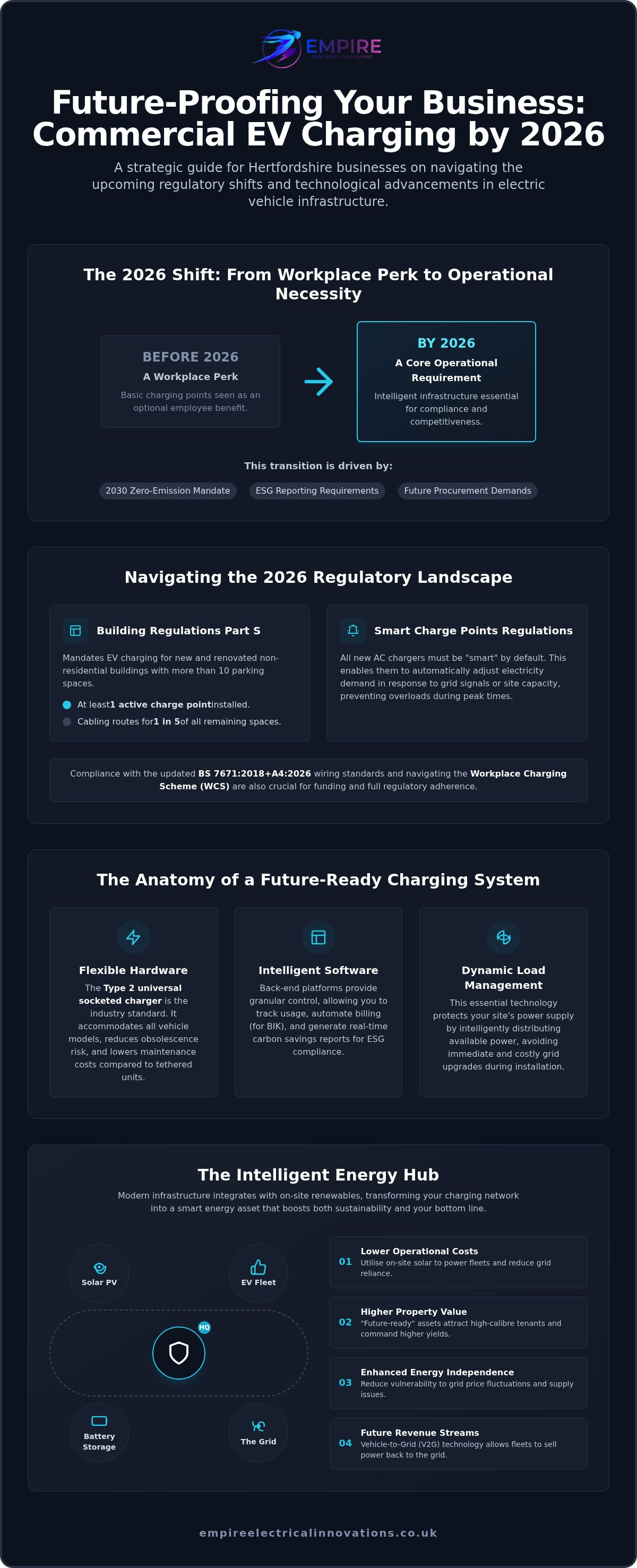
In 2026, the definition of electric vehicle charging infrastructure has expanded beyond simple hardware. It now represents a sophisticated integration of electrical networks, high-performance hardware, and data-driven software required to sustain a commercial fleet. For companies across the South East, a commercial EV charger installation Hertfordshire is no longer a fringe benefit for employees. It's a core operational requirement. Businesses that delay this transition risk falling behind as the 2030 zero-emission mandate draws closer.
The pace of commercial adoption is accelerating. This shift is driven by the need for robust Environmental, Social, and Governance (ESG) reporting. UK companies are now expected to provide transparent data on their carbon reduction efforts. Accurate carbon tracking is a standard metric in corporate disclosures, and proactive infrastructure investment demonstrates a firm commitment to these targets. It also secures the long-term viability of the business whilst avoiding the procurement bottlenecks expected later in the decade.
From Basic Plugs to Intelligent Energy Hubs
The era of "dumb" charging, where a vehicle draws power without communication, has ended. By 2026, workplace charging has evolved into the intelligent energy hub. These systems frequently work in tandem with solar PV for commercial buildings to reduce reliance on the local grid. This synergy allows businesses to harvest renewable energy during daylight hours to power their fleets, significantly lowering operational costs and improving energy independence.
Investment in this technology adds measurable value to commercial real estate. In Hertfordshire, where office and warehouse space is at a premium, "future-ready" assets command higher yields. A site equipped with a robust commercial EV charger installation Hertfordshire attracts high-calibre tenants. These organisations require reliable, scalable charging solutions as a prerequisite for their lease agreements. It's a strategic move that protects the asset's marketability for years to come.
Meeting the 2026 Regulatory Standards
Compliance is the foundation of any modern installation. Building Regulations Part S mandate EV charging infrastructure for all new and renovated non-residential buildings with more than 10 parking spaces. This requires at least one active charge point and cabling routes for one in five of the remaining spaces. Adhering to these standards ensures that your facility remains legally compliant and avoids costly retrospective work.
The Smart Charge Points Regulations also demand that all new AC units are "smart" by default. This ensures that the charging network can respond to the needs of the wider grid, preventing overloads during peak times. In the context of the 2026 UK grid, smart charging is defined as a system capable of sending and receiving data to automatically modulate electricity demand in response to grid signals or site-specific capacity limits.
Core Technologies Driving Workplace Charging Trends
Successful 2026 infrastructure relies on hardware flexibility and data transparency. For most businesses, the Type 2 universal socketed charger has become the industry standard. Unlike tethered units with fixed cables, socketed chargers allow drivers to use their own leads, which accommodates a wider variety of vehicle models. This approach reduces the risk of hardware becoming obsolete. It also minimises maintenance costs, as damaged cables can be replaced by the user rather than requiring an engineer to dismantle the unit. Selecting the right hardware is the first step in a durable bespoke charging design.
The hardware is only as effective as the software managing it. Modern back-end management systems now provide granular control over every kilowatt used on-site. These platforms allow fleet managers to track individual driver usage, automate billing for employee benefit-in-kind (BIK) calculations, and generate real-time carbon savings reports. By 2026, we're also seeing the first commercial trials of Vehicle-to-Grid (V2G) technology. This allows parked fleets to act as a collective battery, discharging power back into the building or the grid during peak demand to generate revenue.
AC vs. DC: Choosing the Right Speed for Your Sector
Selecting the correct charging speed is essential for a high ROI. Fast AC charging, typically between 7kW and 22kW, is the most cost-effective solution for office environments where vehicles remain stationary for several hours. It puts less strain on the local electrical supply and is significantly cheaper to install. Conversely, logistics hubs and transit centres require rapid DC charging. With outputs of 50kW or higher, these units can replenish a delivery van's battery during a short driver break. Matching charger speed to vehicle dwell time prevents over-investment in unnecessarily powerful hardware.
Connectivity and Telecoms Integration
Reliable communication is the backbone of any commercial EV charger installation Hertfordshire. Every smart unit must maintain a constant data link to perform load balancing and process payments. In 2026, this is increasingly achieved through a combination of Wi-Fi 6 and 5G connectivity. To ensure these signals remain stable across large car parks or basement levels, many firms are investing in dedicated commercial telecoms ducting. This physical infrastructure protects data cables and allows for easy future upgrades as network speeds evolve.
Robust connectivity also enables sophisticated Smart Grids and load balancing. This technology allows the charging network to communicate with the building's main supply. It ensures that chargers only draw maximum power when the building's other electrical demands are low. This intelligent distribution of energy prevents fuse failures and allows businesses to install more charge points than their raw grid capacity would otherwise permit.
Overcoming Power Constraints: Load Balancing and Smart Grids
Hertfordshire's commercial landscape often presents a significant technical hurdle: restricted grid capacity. Many older industrial estates and business parks in the county operate on electrical supplies that were never designed to support the simultaneous high-draw load of multiple electric vehicles. Attempting a commercial EV charger installation Hertfordshire without addressing these constraints can lead to frequent fuse failures or prohibitively expensive transformer upgrades from the Distribution Network Operator (DNO). To avoid these pitfalls, a methodical approach to energy management is required.
The solution lies in the distinction between static and dynamic load management. Static management sets a rigid, unchangeable limit on each charger, which often leaves vehicles charging slower than necessary. In contrast, dynamic load management (DLM) monitors the building's total energy consumption in real-time. It then allocates the remaining available power to the charging network. This intelligent distribution prioritises vehicles based on their specific battery needs and the time they have available before their next scheduled departure. For businesses offering public or visitor charging, this technical reliability is a core requirement of the UK Public Charge Point Regulations 2023.
Dynamic Load Management (DLM) Explained
DLM allows for a significantly higher number of chargers on a smaller supply. Consider a facility with enough spare capacity to charge 10 vans simultaneously at full speed. By implementing DLM, that same facility can safely support a fleet of 20 vans. The system intelligently throttles speeds across the network, ensuring every vehicle is ready for the morning shift without ever exceeding the site's safe electrical threshold. Dynamic Load Management effectively eliminates the need for expensive grid reinforcement costs by maximising the utility of existing electrical assets.
The Role of Microgrids in 2026
The most resilient strategy for 2026 involves creating a localised microgrid. By integrating battery storage for solar panels, businesses can buffer peak demand. The battery system charges during periods of low activity or high solar generation, then discharges that stored energy when multiple vehicles plug in at once. This setup creates a self-sustaining local network that reduces your dependence on the National Grid.
This approach is particularly effective for future-proofing against rising commercial energy costs. By discharging stored solar energy during peak tariff periods, you avoid the highest electricity rates. It transforms your charging infrastructure from a simple utility into a strategic energy asset. A well-designed microgrid ensures that your fleet remains operational even if the wider grid faces capacity challenges, providing a level of security that off-the-shelf solutions cannot match.
Navigating Compliance: Hertfordshire Regulations and Grant Funding
Adhering to the latest regulatory framework is the most critical stage of a commercial EV charger installation Hertfordshire. In 2026, the landscape is defined by rigorous electrical standards and specific grid notification requirements. For businesses operating within the UK Power Networks (UKPN) area, which covers most of the county, the application process is methodical. Any installation exceeding certain capacity thresholds requires a formal G99 or G100 application. This process ensures that your local substation can handle the additional load without compromising the stability of the wider network. Failing to secure this approval before commissioning can lead to significant fines or a forced disconnection of your equipment.
Safety and accessibility standards have also seen significant updates. Compliance with PAS 1899:2022 is now a standard expectation for commercial sites, ensuring that charging bays are accessible to drivers with disabilities. This includes specific requirements for clear signage, non-slip surfaces, and adequate space around the charging unit. Beyond physical access, your electrical contractor must provide a full NICEIC certification upon completion. This document is not merely a formality. It's a prerequisite for commercial insurance validity and a mandatory requirement for any future property transactions or lease renewals.
Securing Government Support in 2026
The financial burden of large-scale infrastructure is partially offset by the Workplace Charging Scheme (WCS) grant. As of April 1, 2026, the grant provides up to 75% of the total purchase and installation costs, capped at £500 per socket. This is an increase from previous years, and businesses can claim for a maximum of 40 sockets across multiple sites. For state-funded education institutions in Hertfordshire, the support is even more substantial, with grants available up to £2,000 per socket. These schemes are currently set to remain open until March 31, 2027.
Tax incentives provide further relief for SMEs and larger corporations alike. Under current UK tax law, many businesses can take advantage of capital allowances, which allow for the deduction of the full cost of the installation from pre-tax profits in the first year. We also recommend reviewing Benefit-in-Kind (BiK) considerations for employees who use workplace charging, as these rates remain highly favourable compared to traditional fuel alternatives.
Local Planning and DNO Coordination
Planning permission is often a point of confusion for directors in St Albans, Watford, and Stevenage. Whilst many installations fall under "permitted development" rights, there are exceptions for listed buildings or sites in conservation areas. It's essential to verify the status of your property with the local authority before breaking ground. Coordination with the DNO remains the primary technical hurdle. A professional installer handles these G99 notifications on your behalf, ensuring that the infrastructure is designed to meet the specific capacity limits of your Hertfordshire postcode.
To ensure your project meets every regulatory hurdle from the outset, book a compliant site survey with our technical team.
Future-Proofing Your Business with Empire Electrical Innovations
Empire Electrical Innovations operates as a trusted specialist for complex technical infrastructure. We understand that an off-the-shelf approach to commercial EV charger installation Hertfordshire often leads to operational bottlenecks and wasted capital. Generic units rarely account for the specific load constraints or renewable integration needs of a local business park. Our bespoke design process ensures that every socket installed is a strategic asset, tailored to the unique electrical profile of your facility. We focus on longevity and precision, ensuring your investment remains relevant as vehicle technology evolves.
Our methodology is built on precision and transparency. Every project begins with a comprehensive site survey where we assess your current capacity and future growth targets. From design and DNO coordination to the final commissioning, we manage the technical burden on your behalf. This methodical approach is informed by our extensive work with commercial EV charger installation in London. The challenges of high-density urban environments have refined our ability to deliver robust infrastructure in the most demanding settings; a level of expertise we now apply to our Hertfordshire clients.
A Partnership-First Approach
We view our clients as long-term partners rather than simple transactions. This is particularly vital for property managers and developers who must plan for scalable growth across multiple years. We provide transparent, itemised quoting with no hidden infrastructure costs. You'll receive a clear roadmap that aligns with your ESG goals and building compliance requirements. Our commitment to high-standard workmanship is backed by our NICEIC status and a disciplined focus on the latest UK wiring regulations. We don't just install hardware. We build the foundation for your future energy independence.
Post-installation support is a core pillar of our service. We offer ongoing maintenance contracts and remote support for business parks across the county. This proactive monitoring ensures that your charging network maintains maximum uptime, protecting your reputation with both employees and visitors. If a fault occurs, our engineers can often diagnose and resolve the issue via the back-end software before it impacts your fleet operations.
Start Your Infrastructure Journey
Securing your 2026 energy strategy begins with a professional assessment. To prepare for your initial consultation, it's helpful to have your recent energy bills and any existing site plans available. This data allows our engineers to provide more accurate preliminary advice on load management and potential solar integration. We'll guide you through the grant application process to ensure you maximise the available government support.
Take the first step toward a resilient, compliant charging network. Contact Empire Electrical Innovations for a bespoke commercial quote and book your free site survey today.
Secure Your 2026 Energy Future
Commercial EV infrastructure has evolved from a simple amenity into a vital energy asset. By integrating dynamic load management and renewable systems, Hertfordshire businesses can avoid the high costs of grid upgrades whilst meeting the strict compliance standards of the 2026 regulatory landscape. Successfully navigating the Workplace Charging Scheme and G99 notifications requires a methodical approach that prioritises long-term scalability over quick fixes.
A professional commercial EV charger installation Hertfordshire ensures your facility is ready for the total electric transition. As a NICEIC Approved Contractor and OZEV Authorised Installer, Empire Electrical Innovations specialises in integrated solar and EV solutions designed for performance. We don't just provide hardware; we deliver the technical expertise needed to turn complex infrastructure into a seamless operational advantage. Your journey toward a sustainable, high-ROI fleet starts with a clear, compliant strategy.
Frequently Asked Questions
What is the Workplace Charging Scheme grant for 2026?
The Workplace Charging Scheme (WCS) grant currently covers up to 75% of the total purchase and installation costs, capped at £500 per socket. This rate increased from £350 on April 1, 2026, to provide greater support for businesses transitioning their fleets. Organisations can claim for a maximum of 40 sockets across their sites, with the scheme currently extended until March 31, 2027. State-funded education institutions receive a higher cap of £2,000 per socket.
How much power does a commercial EV charger installation require?
Power requirements depend entirely on the charger speed and the quantity of units. A standard 7kW AC charger typically requires 32 amps on a single-phase supply, whilst a 22kW unit necessitates a three-phase connection. Rapid DC chargers (50kW+) demand significantly higher capacity. During a commercial EV charger installation Hertfordshire, we conduct a full load analysis to determine if your existing supply can support these requirements without a grid upgrade.
Do I need planning permission for EV chargers at my Hertfordshire office?
Most commercial EV installations fall under "permitted development" and don't require formal planning permission. There are specific exceptions for listed buildings or sites located within conservation areas, which are common in historic areas like St Albans or Hitchin. You must also ensure that wall-mounted units and pedestals don't exceed the height and size limits defined in the current planning regulations for non-domestic land.
Can I link my commercial solar panels to my EV charging points?
You can link your solar PV system directly to your charging infrastructure to create a highly efficient energy hub. Using an intelligent management system allows you to prioritise self-generated renewable energy for your vehicles during daylight hours. This synergy reduces your reliance on the National Grid and protects your business against volatile commercial energy prices whilst improving your overall ESG rating.
What is the difference between AC and DC charging for businesses?
The difference lies in the conversion of electricity and the resulting charging speed. AC chargers (7kW–22kW) are cost-effective solutions for long-stay parking where vehicles remain stationary for several hours. DC chargers (50kW+) provide much faster speeds by converting power within the unit itself and delivering it directly to the battery. DC is the preferred choice for logistics hubs and transit centres requiring rapid turnaround times.
How many EV chargers can I install on my existing electrical supply?
The number of chargers depends on your spare capacity and the implementation of Dynamic Load Management (DLM). DLM monitors your building's total demand and allocates power to the chargers only when it's safe to do so. This technology often allows businesses to install twice as many chargers as their raw electrical supply would suggest, effectively bypassing the need for expensive and time-consuming grid reinforcements.
What is the ROI on commercial EV charging infrastructure?
ROI is delivered through lower fleet fuel costs, enhanced property value, and the ability to attract high-calibre tenants. Businesses can also generate direct revenue by making their chargers available to the public or visitors via a paid charging platform. When combined with capital allowances and the current OZEV grants, the initial investment often pays for itself through operational savings and tax benefits within a few years.
Are there specific regulations for EV charging in public car parks in 2026?
Publicly accessible chargers must adhere to the Public Chargepoint Regulations 2023. These regulations mandate 99% reliability across a network, contactless payment for units above 8kW, and transparent pricing displayed in pence per kilowatt-hour. Additionally, Building Regulations Part S requires all new commercial buildings with more than 10 parking spaces to include at least one active charger and passive infrastructure for 20% of the remaining bays.


Comments