
Part L Building Regulations and Solar Panels: A 2026 Developer’s Guide

Updated: Aug 2
A 75% reduction in CO2 emissions is no longer an aspirational target; it's a legal requirement for every new home built in England from 24 March 2027. We understand that the shift from SAP 10.2 to the new Home Energy Model brings significant uncertainty, particularly regarding the rising costs of low-carbon compliance. Navigating the updated Part L building regulations solar panels mandates requires more than just a tick-box approach. It demands a methodical strategy to balance technical standards with commercial viability.
You're likely feeling the pressure of these new functional requirements, such as the mandate for on-site generation equivalent to 0.22 kWp per square metre of floor area. This guide provides a clear roadmap through the 2026 regulations, showing you how to achieve compliance whilst maximising development value. We'll examine the specific solar PV and battery storage metrics you need to meet, explore cost-effective installation strategies, and explain how a specialist partner can secure your project's future-readiness across Hertfordshire, Bedfordshire, and London.
Table of Contents
Understanding Part L Building Regulations: The 2026 Landscape for Developers
The Role of Solar Panels in Meeting Part L Compliance Targets
Strategic Energy Planning: Solar PV vs Alternative Low-Carbon Technologies
Future-Proofing Developments: A Practical Implementation Roadmap
Expert Solar Design and Compliance for South East Property Developers
Understanding Part L Building Regulations: The 2026 Landscape for Developers
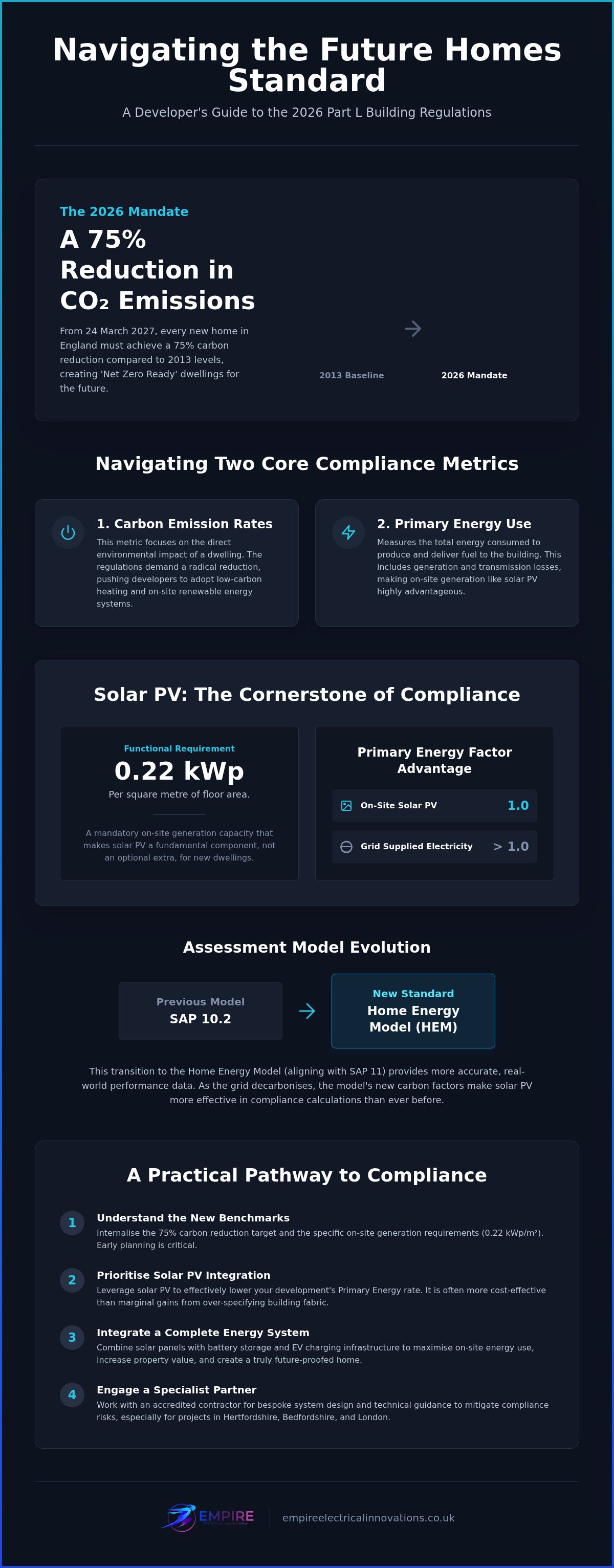
The UK Building Regulations framework has undergone its most rigorous update in a decade. Approved Document L, which focuses on the conservation of fuel and power, now sets a formidable benchmark for developers. Whilst the 2021 interim uplift targeted a 30% reduction in carbon emissions, the 2026 standards demand a 75% reduction compared to 2013 levels. This shift marks the definitive transition to the Future Homes Standard. For construction projects across Hertfordshire and the South East, "Net Zero Ready" is the new operational reality. It means homes must be capable of becoming fully carbon neutral as the grid decarbonises, without the need for future retrofitting.
Developers must now navigate two distinct metrics: carbon emission rates and primary energy use. Carbon targets focus on the environmental impact, whilst primary energy metrics measure the efficiency of the energy source and the building's infrastructure. Achieving these goals requires a technical shift away from fossil fuels toward integrated renewable systems. These regulations apply to new dwellings in England from 24 March 2027, with a transitional period running until 24 March 2028 for projects already commenced. This timeline leaves little room for hesitation in planning compliant energy strategies.
Volume 1 vs Volume 2: Dwellings and Non-Dwellings
Part L is divided into two volumes with specific requirements. Volume 1 governs residential dwellings, including houses and blocks of flats. Volume 2 applies to non-dwellings such as offices and warehouses. In London urban centres, mixed-use developments often fall under both volumes, creating a complex compliance landscape. Residential units must meet stringent fabric standards and on-site generation targets. Commercial spaces in the same building must often implement more intensive heat recovery and high-efficiency lighting to satisfy Volume 2 criteria. Each volume requires a tailored approach to ensure the entire development remains compliant and commercially viable.
The Impact of SAP 10.2 and SAP 11 on Solar Design
Compliance is validated through the Standard Assessment Procedure (SAP). We are currently in a transition from SAP 10.2 to SAP 11, which aligns with the new Home Energy Model (HEM). This model provides more accurate, real-world energy performance data. The carbon factor of electricity has dropped significantly as the grid incorporates more renewable sources. This makes Part L building regulations solar panels integration more effective in SAP calculations than ever before. Early-stage solar PV design and installation is now essential. Waiting until the final stages of a build to consider renewables often leads to costly redesigns or failure to meet the 75% reduction target. Precise, data-driven design ensures your project meets these technical thresholds from the outset.
The Role of Solar Panels in Meeting Part L Compliance Targets
Solar PV is no longer an optional addition for new developments. It is a fundamental component of a modern energy strategy. Under the latest Approved Document L, buildings are assessed on their Primary Energy rate. This metric considers the energy used to produce and deliver fuel to the site. Because solar energy is generated on-site, it carries a primary energy factor of 1.0, which significantly outperforms grid-supplied electricity. By generating power at the point of use, developers can bridge the gap between high-performance building fabric and the mandatory 75% carbon reduction target.
Relying solely on a "fabric-first" approach has reached a point of diminishing returns. Chasing marginal gains through extreme insulation thickness or ultra-high-specification glazing often incurs higher capital costs than installing a high-efficiency solar array. In Buckinghamshire, local planning authorities are increasingly demanding on-site renewables that exceed national minimums to meet local climate targets. Integrating Part L building regulations solar panels provides a predictable, cost-effective route to compliance whilst increasing the eventual market value of the dwelling.
Optimising Solar PV Capacity for Multi-Unit Developments
Calculating the correct system size is vital for project viability. The current benchmark for new dwellings involves a solar PV system with a peak power equivalent to 0.22 kWp per square metre of the building's ground floor area. For multi-unit developments, this requires precise roof mapping to manage orientation and potential shading from adjacent structures. Solar PV reduces the dwelling emission rate (DER) by providing zero-carbon electricity that directly offsets the target emission rate (TER) required by the building control body.
Integrating Battery Storage to Boost Energy Ratings
Battery storage is a critical lever in modern SAP calculations. By capturing excess solar generation, these systems increase self-consumption rates and reduce the building's reliance on the grid during peak periods. This technical integration is central to maximising efficiency with solar battery installation in Hertfordshire. We frequently specify GivEnergy battery storage as a future-proof solution because it allows homeowners to store energy for use when the sun isn't shining, further lowering the Primary Energy rate. If you are designing a new scheme, our team can provide a bespoke solar and storage design to ensure your project meets its technical thresholds from day one.
Strategic Energy Planning: Solar PV vs Alternative Low-Carbon Technologies
Strategic energy planning requires a precise balance between capital expenditure and long-term compliance. While Air Source Heat Pumps (ASHPs) are often positioned as the primary solution for low-carbon heating, they significantly increase a site's electrical demand. Relying solely on ASHPs without on-site generation can lead to higher operational costs for residents and potential grid connection challenges for developers. A hybrid strategy, combining heat pumps with Part L building regulations solar panels, has become the industry standard. This approach offsets the increased electrical load of the heating system whilst satisfying the stringent carbon reduction targets set out in the Official Part L Building Regulations.
The "Fabric First" principle remains a core tenet of UK construction. However, insulation alone is no longer sufficient to meet the 75% reduction benchmark. There is a point where increasing wall thickness or triple glazing becomes less cost-effective than investing in renewable technology. For developers in Cambridgeshire, managing CAPEX is critical. Integrating solar PV often provides a better return on investment than extreme fabric upgrades, especially when factoring in the Home Energy Model's preference for on-site generation. Key advantages of this hybrid approach include:
Reduced reliance on expensive, high-specification building materials.
Lowered dwelling emission rates (DER) through on-site renewable generation.
Improved marketability to energy-conscious buyers and tenants.
Future-proofed infrastructure that supports the transition to all-electric heating.
The Problem with Gas Boilers in 2026
Traditional gas boilers are effectively obsolete for new-build projects. The 2026 regulations make it virtually impossible to meet carbon targets using fossil fuel heating. This transition to all-electric homes necessitates a robust electrical infrastructure. Solar PV bridges the energy gap. It provides a dedicated source of clean energy to power heat pumps and domestic appliances. Developers must now account for higher electrical load requirements during the early design phase to avoid grid capacity bottlenecks. Using Part L building regulations solar panels ensures that these all-electric properties remain affordable to run for the end-user.
Commercial Solar PV for Business Parks and Warehouses
Part L Volume 2 dictates the energy standards for non-domestic buildings. For business parks and warehouses, the roof space represents a significant commercial asset. A well-designed solar PV for commercial buildings installation can be a powerful tenant incentive. It reduces service charges and helps corporate occupiers meet their own ESG targets. Industrial units with large-scale roof-mount systems require specific design considerations, including structural load-bearing assessments and high-capacity inverter configurations to handle the output. Meeting these standards is essential for maintaining the long-term asset value of commercial portfolios.
Future-Proofing Developments: A Practical Implementation Roadmap
Future-proofing a development requires a holistic view of the regulatory landscape. Part L (Energy) and Part S (Infrastructure for Electric Vehicles) are inextricably linked. By aligning these requirements early, developers can avoid the inefficiencies of retrofitting chargers or upgrading supply capacities later. A single-contractor approach for electrical and renewable infrastructure ensures that solar PV, battery storage, and EV charging points operate as a cohesive system. This unified design reduces technical friction and simplifies the management of Distribution Network Operator (DNO) applications, which are increasingly complex in Hertfordshire and the wider South East due to grid capacity constraints.
Beyond energy, modern sites must integrate telecoms infrastructure alongside power planning. Our experience in commercial telecoms, including fibre blowing and Test Rod and Rope (TRR) services, allows us to provide a comprehensive infrastructure solution. This methodical approach ensures that every aspect of the site's connectivity and energy generation is future-ready. Managing these elements through one specialist partner eliminates the communication gaps that often occur between different trades, ensuring that Part L building regulations solar panels are integrated without compromising other critical site utilities.
Integrating EV Charging with Solar Infrastructure
Part S compliance is more than just installing a socket. It requires optimising site-wide electrical loads to prevent grid overloads. We specialise in commercial EV charger installation in Hertfordshire, focusing on smart charging technologies. These systems can be configured for solar-matching, allowing residents to charge vehicles using surplus energy generated by their Part L building regulations solar panels. This synergy reduces the building's Primary Energy rate whilst providing a high-value feature for prospective buyers who prioritise sustainable living.
Site Surveys and Compliance Documentation
Rigorous documentation is the foundation of Building Control sign-off. A professional solar survey and quote at the design stage provides the data needed for accurate SAP modelling and Home Energy Model (HEM) validation. We ensure every project is backed by MCS certification and NICEIC compliance, providing the necessary evidence for regulatory validation. This methodical attention to detail protects the development's legal standing and ensures that the installed systems perform exactly as predicted in the initial energy calculations. For a partner who understands the intersection of energy and infrastructure, request a technical consultation for your next development.
Expert Solar Design and Compliance for South East Property Developers
Local knowledge is a critical asset in a tightening regulatory environment. Planning departments in Hertfordshire and Bedfordshire often set high expectations for renewable energy integration that exceed national baselines. We provide the technical expertise to meet these demands without compromising your construction timeline. Our bespoke design services ensure your Part L building regulations solar panels strategy is optimised for your specific site layout and SAP targets. We manage the technical complexities. You focus on the build. Navigating South East grid constraints requires a methodical approach to DNO applications, and our team ensures these processes are handled early to avoid site delays.
Property managers and developers must secure their 2026 compliance strategy now. The transition to the Future Homes Standard means that every technical decision made today impacts the project's viability in 2027 and beyond. We act as a reassuring partner throughout this process. We provide the data and documentation required for seamless Building Control sign-off. By integrating solar PV and battery storage at the design stage, you protect your development from the rising costs of late-stage compliance adjustments. Our goal is to provide a secure, future-ready infrastructure that enhances the overall value of your portfolio.
Why Partner with a Specialist Renewable Contractor?
Generic electrical contractors often lack the technical depth required for MCS-compliant solar design. Errors in system sizing or poor documentation can lead to significant delays in Building Control sign-off. We provide NICEIC and MCS accredited installations. This guarantees that your renewable infrastructure meets every regulatory standard. There are several clear benefits to this specialist approach:
Accurate SAP modelling support to ensure your Part L building regulations solar panels meet 75% carbon reduction targets.
Seamless integration with battery storage and EV charging infrastructure to maximise site-wide efficiency.
Long-term monitoring and maintenance support for commercial property portfolios.
Enhanced development resale value through high-quality, certified workmanship.
Start Your Compliance Journey Today
Securing compliance for 2026 starts with an accurate assessment of your site's potential. We offer free site surveys for developers across Hertfordshire, Bedfordshire, and London. These surveys form the basis of a tailored quotation that aligns our technical solutions with your construction budget. We don't believe in empty promises. We deliver methodical, disciplined results that get the job done right. Contact our Hertfordshire-based team today to discuss your next project. We're ready to provide the expert advice and reliable installation services you need to navigate the 2026 landscape with confidence.
Securing Your Development’s Technical Future
The 2026 transition to the Future Homes Standard represents a fundamental shift in construction methodology. Success now depends on viewing energy infrastructure as a central design pillar rather than an afterthought. By integrating high-efficiency solar PV with battery storage and EV charging, you don't just satisfy the 75% carbon reduction mandate; you create homes that are more marketable and cheaper to run. This methodical approach ensures that navigating Part L building regulations solar panels requirements becomes a clear, manageable process for your project team.
As a trusted specialist, we provide the technical rigour needed to secure Building Control sign-off across Hertfordshire, Bedfordshire, Buckinghamshire, and London. Our NICEIC and MCS accredited team handles everything from initial SAP modelling support to complex DNO applications. We're here to ensure your developments remain compliant, future-ready, and commercially robust. Providing bespoke solutions is at the heart of what we do, ensuring your project meets its targets on time and within budget.
Request a professional solar survey and quote for your development to begin your compliance journey. We look forward to partnering with you on your next sustainable project.
Frequently Asked Questions
What are the main changes to Part L building regulations for 2026?
The 2026 update mandates a 75% reduction in carbon emissions compared to 2013 baselines. It introduces a functional requirement for on-site renewable energy, specifically a solar PV system benchmark of 0.22 kWp per square metre of ground floor area. These changes represent the full implementation of the Future Homes Standard, moving the industry toward the new Home Energy Model.
Do all new-build homes require solar panels to meet Part L standards?
Whilst solar panels aren't technically mandatory for every project, they're the most cost-effective way to achieve the 75% carbon reduction target. Alternative fabric-only strategies are often prohibitively expensive and technically difficult to implement. Integrating Part L building regulations solar panels into your design is now the standard route for securing Building Control approval in 2026.
How do solar panels improve a building’s SAP rating?
Solar PV directly lowers the Dwelling Emission Rate (DER) and the Primary Energy rate within the Standard Assessment Procedure. By generating zero-carbon electricity on-site, you offset the energy demand of the building's heating and lighting systems. This reduction is critical for meeting the strict compliance thresholds required for new-build developments in the South East.
Can I use battery storage to help achieve Part L compliance?
Battery storage is a vital tool for compliance because it increases the building's self-consumption rate. By storing excess solar energy for evening use, you reduce the Primary Energy metric in the Home Energy Model calculations. This technical integration is particularly effective when pairing Part L building regulations solar panels with high-performance battery storage systems to reduce grid reliance.
What is the difference between Volume 1 and Volume 2 of Approved Document L?
Volume 1 of Approved Document L covers residential dwellings, including houses and blocks of flats. Volume 2 applies to non-dwellings, such as commercial offices, warehouses, and industrial units. Each volume has distinct targets for carbon emissions and primary energy, meaning developers must apply different design strategies depending on the building's intended use.
How does Part L affect the installation of EV chargers on new sites?
Part L and Part S work in tandem to create a sustainable site infrastructure. Whilst Part S mandates the installation of EV chargers, Part L requires the building to remain energy efficient despite the increased demand. Solar PV helps manage the higher electrical load of EV charging, ensuring the development meets its carbon targets without requiring expensive grid reinforcements.
Is hardside telecoms infrastructure part of the energy compliance process?
Telecoms infrastructure isn't a direct requirement of Part L, but it's essential for the smart energy monitoring required by the Home Energy Model. Robust connectivity allows for the real-time performance tracking of solar and battery systems. We integrate telecoms planning, such as fibre blowing and TRR services, with energy infrastructure to ensure your site is fully connected and future-ready.
How can I ensure my development is "Net Zero Ready" for 2026?
To ensure a development is "Net Zero Ready," you must eliminate fossil fuel heating and maximise on-site renewable generation. This typically involves installing air source heat pumps alongside high-performance solar PV and battery storage. These homes are designed to become fully carbon neutral as the national grid continues to decarbonise, avoiding the need for future retrofitting.


Comments