
Solar for Schools UK: 2026 Funding & Installation Guide

Secondary schools across Britain are currently saving an average of £58,600 every year by transforming their roof space into a high-performance power plant. For primary schools, these annual savings typically reach £21,000. These figures represent more than just environmental progress; they are vital funds that can be redirected from utility bills straight back into teaching and student resources.
As a school governor or business manager, you've likely felt the weight of rising energy costs eating into your educational budget. The 2026 landscape for solar energy for schools UK offers significant opportunities, yet it's often overshadowed by confusion regarding Great British Energy grant eligibility and concerns over structural roof compliance. You need a partner who understands that safety and academic continuity are non-negotiable.
This guide provides a comprehensive roadmap to navigate the current funding models, including the £100 million Great British Energy fund and the recently reinstated Power Purchase Agreements. We will detail how to secure your installation against future price volatility whilst ensuring every panel meets the highest safety standards. From initial site surveys to long-term battery storage integration, this is your blueprint for a resilient, sustainable, and cost-effective energy future.
Table of Contents
The Landscape of Solar Energy for Schools in the UK (2026)
Solar energy for schools UK is a tool for both financial stability and environmental education. In 2026, the definition of solar PV has evolved significantly. It's no longer just a simple roof-mounted array. Instead, it is a sophisticated energy management system that integrates generation, battery storage, and intelligent monitoring. This shift aligns with the 2026 Net Zero imperative, positioning schools at the heart of the Renewable energy in the United Kingdom transition. Schools are uniquely placed to lead this change, utilising their large roof areas to contribute to the national grid whilst securing their own power supply.
For UK academies and Local Education Authority (LEA) schools, solar has transitioned from an optional green initiative into a core financial strategy. This move mirrors the broader adoption of commercial solar PV across the public sector. By generating power on-site, schools gain control over their operational costs whilst reducing their carbon footprint. These bespoke systems are engineered for longevity, ensuring that the technical infrastructure remains relevant as technology advances. It's a methodical approach to future-proofing that provides a sense of security for governors and business managers alike.
Current Challenges Facing School Energy Budgets
School energy budgets face relentless pressure from external factors. Global market volatility directly impacts institutions where average usage sits at 10kWh per square foot of floor space. Ageing infrastructure and inefficient heating systems often create hidden costs that drain limited resources. Solar PV provides a robust solution to these systemic issues. It acts as a fixed-cost energy hedge for the next 25 years. This stability allows business managers to forecast budgets with precision. It shields educational outcomes from external price shocks that would otherwise force difficult decisions regarding staff or resources.
The Educational Value of On-Site Renewables
The benefits of solar energy for schools UK extend beyond the balance sheet. On-site renewables offer immense educational value. By integrating real-time generation data into the STEM curriculum, pupils engage with tangible science. The school becomes a living laboratory. Students can study thermoregulation and energy physics in a real-world context. This commitment to sustainability also enhances the school's reputation amongst eco-conscious parents and the local community. It projects an image of a methodical, disciplined institution. It demonstrates a forward-thinking approach that prepares students for the realities of a decarbonised economy.
Why Schools are Prioritising Solar PV and Battery Storage
Modern educational facilities are shifting their focus toward total energy independence. Whilst early adopters focused purely on generation, the current trend for solar energy for schools UK emphasises the integration of storage. Systems ranging from 11kW to 50kW are becoming the standard for most institutions. This sizing allows schools to maximise self-consumption during school hours whilst providing enough surplus to charge batteries for use during non-operational periods. This strategic approach is supported by the government solar drive, which highlights the importance of reducing long-term utility overheads.
By managing energy on-site, governors can significantly reduce peak demand charges. These fees are often highest when the school is most active, particularly during the winter months. A combined system of solar PV and battery storage allows the building to draw from its own reserves rather than the grid during these expensive windows. It's a methodical way to future-proof the school against a volatile energy market that shows no signs of stabilising.
The Synergy of Solar and Battery Storage
The primary challenge for any school is the mismatch between peak generation and peak usage. Solar arrays generate the most power during weekends and summer holidays when the building is largely empty. Without storage, this clean energy is exported to the grid for a minimal return. By installing battery storage for solar panels, a school effectively transforms into a mini-power plant that can store daytime sun for evening security lighting and 24/7 IT servers.
Peak Shaving: Batteries discharge during the high-demand morning period, reducing expensive peak-rate charges from the grid.
Holiday Capture: Six weeks of summer sun can be stored and used to power maintenance work or essential systems throughout August.
Operational Continuity: Storage provides a buffer against local grid fluctuations, ensuring sensitive educational technology remains protected.
Supporting the Transition to EV Charging
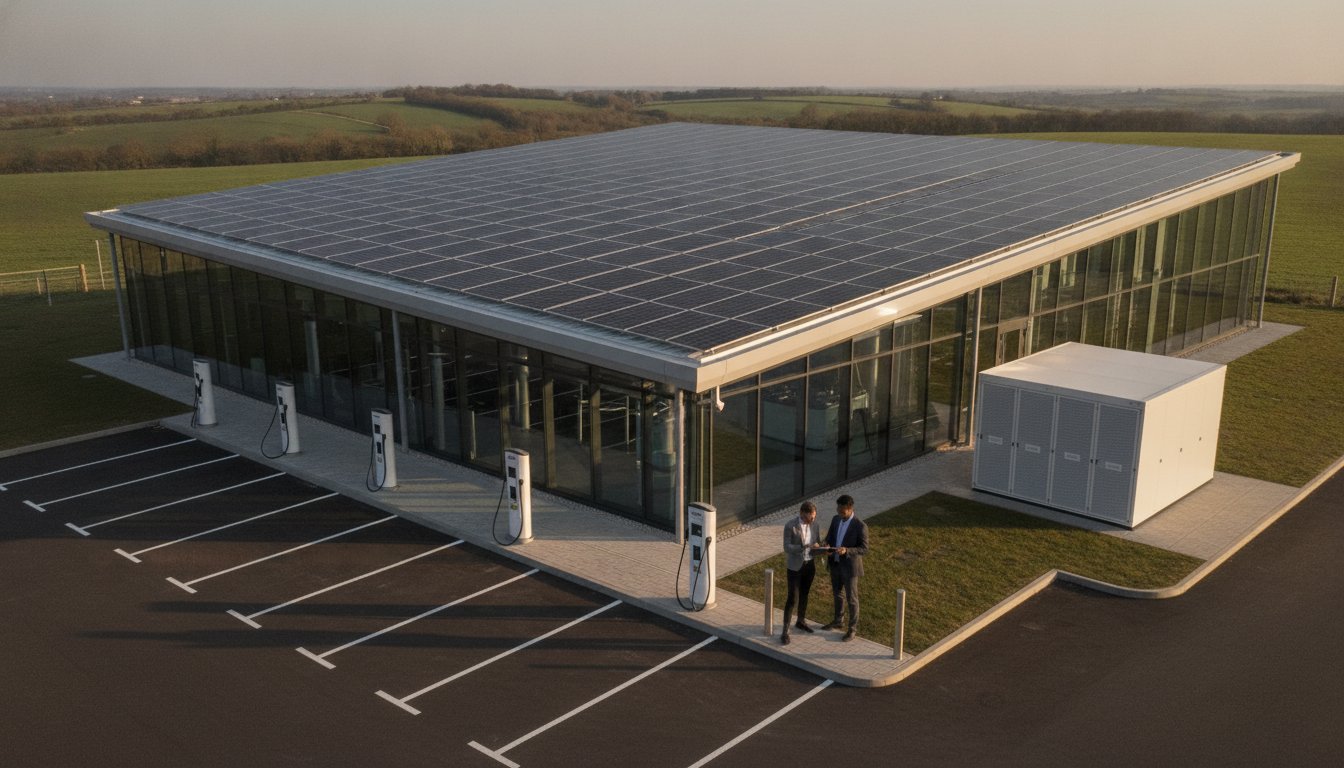
Future-proofing a school means preparing for the electrification of transport. Many schools face high costs when trying to upgrade their local grid connection to support staff car parks. Integrating solar and storage allows for commercial EV charger installation without these prohibitive infrastructure fees, making solar energy for schools UK a vital component of modern site management. The solar energy generated on-site can be diverted directly into staff vehicles, acting as a powerful tool for teacher retention and recruitment.
Some academies are also exploring revenue generation by offering charging access to the local community outside of school hours. This creates a circular economy where the school's roof generates the power, and the community provides the funding for future educational projects. To understand how these systems fit your specific site, a bespoke energy assessment is the best way to determine your potential for energy independence.
Funding and Grants: Navigating the Great British Energy Rollout
Securing funding for solar energy for schools UK requires a methodical approach to the 2026 financial landscape. The flagship initiative is the Great British Energy "Solar for Schools" partnership. This government solar programme for schools is backed by a £100 million fund designed to support educational institutions and the NHS through 2030. Priority is currently given to schools in disadvantaged areas, though local authority support in Hertfordshire and Buckinghamshire remains a vital secondary route for South East academies seeking to reduce their carbon footprint.
Whilst the Public Sector Decarbonisation Scheme (PSDS) Phase 4 portal has closed for new applications, successful projects are now in the delivery phase with a completion deadline of March 2028. For those who missed this window, the Salix Recycling Fund offers 0% interest loans. These are repaid directly from energy savings over a five-to-eight-year period. Alternatively, the Department for Education (DfE) lifted the pause on Power Purchase Agreements (PPAs) in January 2026. This allows schools to install solar PV with zero upfront capital cost, purchasing the generated electricity at a discounted rate from a private investor.
Government Funding vs. Private Investment
Direct ownership through grants or loans provides the highest long-term return on investment. It allows the school to keep 100% of the energy savings and any Smart Export Guarantee (SEG) revenue. In contrast, the PPA model removes the financial barrier of entry but shares the savings with the investor. When planning new school blocks, these systems must align with Part L building regulations to ensure the new infrastructure meets mandatory carbon reduction targets from day one. This integration is essential for future-proofing the school's estate.
Steps to Securing a Solar Grant in 2026
A successful application begins with a rigorous viability analysis. Funders require precise evidence of a project’s potential impact before they commit resources. This methodical preparation ensures that the installation is both technically sound and financially responsible. To build a compelling case, schools should focus on several core requirements.
Energy Data: You must provide 12 months of half-hourly data to prove the system is sized correctly for your specific consumption patterns.
Structural Readiness: Evidence that the roof is capable of supporting the array without compromising safety standards or structural integrity.
Compliance: Grant providers mandate the use of an MCS-certified installer to ensure the system meets national performance benchmarks and safety regulations.
VAT Alignment: Ensure your project takes advantage of the 0% VAT rate on solar and battery installations, which remains in place until March 31, 2027.

The Installation Journey: Planning, Compliance, and Minimal Disruption
A successful project for solar energy for schools UK relies on a disciplined, four-phase approach. It begins with bespoke design. Structural roof surveys are essential to confirm the building can support the weight of a PV array. Once the design is finalised, we manage the G99 grid connection applications. This ensures the local Distribution Network Operator (DNO) approves the system’s capacity. Whilst most rooftop installations are permitted development, we verify planning requirements to avoid future compliance issues. This methodical preparation prevents delays and ensures the system is built to last.
Safeguarding is our primary concern during the physical installation. We prioritise works during school holidays or weekends to eliminate student interaction. If term-time work is necessary, we coordinate with the business manager to schedule "quiet works" around exams or core learning hours. All on-site personnel are fully DBS-checked. This methodical planning ensures a seamless transition to renewable power without compromising academic standards. It provides a sense of security for the entire school community.
Managing the School Environment
Schools require precise coordination. We don't just install panels; we integrate them into the school's existing technical infrastructure. This often involves working with specialist telecoms contractors for data cabling. This ensures the monitoring dashboard has a secure, reliable connection to the school’s network. Site safety remains paramount throughout. We maintain strict exclusion zones and clear communication with the site team to manage logistics effectively. This approach minimises the impact on daily school life whilst maintaining high workmanship standards.
Compliance and Long-Term Maintenance
Longevity is built on rigorous maintenance. We provide annual Operation and Maintenance (O&M) checks to verify electrical safety and performance. This isn't a "fit and forget" service. We train your site manager to track generation data using an intuitive dashboard. This allows the school to identify and address any performance dips immediately. Every system we install meets the latest fire safety and electrical standards for public buildings. This ensures your investment remains secure and productive for the next 25 years. To begin your school's transition, you can book a professional site survey today.
Bespoke Energy Solutions for Schools in the South East
Local expertise is the foundation of a successful energy transition. Schools in Hertfordshire, Bedfordshire, and Buckinghamshire face distinct regional challenges, from specific planning nuances to varying grid capacities. Empire Electrical Innovations provides a "Trusted Specialist" approach to commercial solar PV, ensuring every installation is bespoke to the site's requirements. We don't offer generic packages. Instead, we deliver a holistic model that moves seamlessly from the initial survey to a future-ready energy infrastructure. This methodical process provides school governors with the confidence that their investment is secure, compliant, and engineered for long-term performance.
Our delivery model prioritises precision. We recognise that educational environments require a partner who values workmanship over empty promises. By focusing on the South East, we maintain a responsive presence. This allows us to provide ongoing support and rapid site visits when necessary. We believe that solar energy for schools UK should be a collaborative project, not just a transaction. Our goal is to create a compliant, efficient system that serves the school for decades. This commitment to high standards is what defines our reputation amongst educational business managers.
Tailored Solutions for Hertfordshire and London Schools
London-based academies often navigate complex urban constraints. Shading from surrounding buildings and restricted site access require advanced design simulations to ensure generation targets are met. In contrast, schools across Buckinghamshire frequently occupy traditional 1960s and 70s builds. These structures require detailed structural assessments to maximise roof space whilst maintaining safety. We apply a sense of "quiet authority" to these challenges. We find technical solutions that respect the building's heritage whilst upgrading its performance for the 2026 energy landscape. It's about precision over flashiness.
Contact Empire for a Partnership-First Approach
A partnership-first approach starts with clear communication and technical transparency. We provide bespoke quotations that account for your school's specific usage patterns, including options for battery storage and EV charging infrastructure. This ensures your system is balanced and scalable. We also support school business managers throughout the grant application process, providing the technical data required for Great British Energy or Salix funding bids. We understand the pressure of budget cycles and work to align our delivery with your financial timelines.
Taking the first step is straightforward. We offer a free, no-obligation site survey to assess your roof's potential and your current electrical infrastructure. This survey provides the essential data needed to build a robust financial case for your governors. It's a methodical, risk-free way to explore how solar energy for schools UK can transform your budget. Contact us today to organise your assessment and begin your journey toward energy independence.
Securing Your School’s Energy Future
Transitioning to solar is a strategic shift towards long-term financial resilience. By integrating generation with battery storage, your institution can hedge against market volatility whilst providing a tangible sustainability model for pupils. Managing the 2026 funding landscape, from Great British Energy grants to private PPAs, requires a methodical approach to data and compliance.
Empire Electrical Innovations acts as your trusted specialist throughout this journey. Our MCS Certified installers and DBS-checked team ensure every project meets the highest safety and performance standards without disrupting the academic calendar. We bring specific expertise in Great British Energy funding applications to help you secure the necessary capital. It's a practical, future-proofed investment in your school's next 25 years.
Book your free school solar survey with Empire Electrical Innovations to begin your transition to solar energy for schools UK.
Frequently Asked Questions
How much can a UK school save with solar panels in 2026?
Financial returns extend beyond lower utility bills. Whilst individual institutions see significant reductions in overheads, the solar energy for schools UK programme is estimated to save the sector a combined £220 million over the system lifetimes. Furthermore, schools can earn through the Smart Export Guarantee (SEG). With 2026 rates ranging from 3p to over 25p per kWh, a typical system can generate several hundred pounds in annual revenue simply by exporting surplus energy during holidays.
Are there specific grants for solar panels for schools in England?
Yes, the 2026 landscape features multiple targeted streams. The Great British Energy partnership was recently expanded with an additional £40 million to support another 100 schools. Academies and sixth-form colleges should also investigate the Condition Improvement Fund (CIF) for energy efficiency projects. For solar energy for schools UK, these grants often prioritise institutions in disadvantaged areas, particularly within the West Midlands and North East, though local South East funding remains available.
Will the solar panel installation disrupt school hours or exams?
Disruption is avoided through methodical project management and strict adherence to the latest wiring regulations. We ensure all work complies with BS 7671 Amendment 4, which became mandatory in October 2026. By utilising remote monitoring technology and off-site pre-configuration, we reduce the time spent on your roof. This allows us to complete the majority of the technical commissioning during half-term breaks or weekends, ensuring a quiet environment for students and staff.
How long do solar panels last on a school roof?
Modern PV modules are built for extreme durability with a typical lifespan exceeding 25 years. You should expect a minor power degradation of approximately 0.5% per year, meaning the system remains highly productive for decades. If you integrate battery storage, LiFePO4 cells are now standard, offering thousands of charge cycles. This longevity ensures that the technical infrastructure we install today serves as a reliable energy asset for the next generation of pupils.
Can schools sell excess solar energy back to the National Grid?
Schools can certainly monetise their surplus energy. To do this, the system must be registered with the local Distribution Network Operator (DNO). Smaller systems use a G98 application, whilst larger arrays require a more complex G99 application. This registration is a mandatory requirement for accessing Smart Export Guarantee (SEG) payments. It allows the school to turn empty summer buildings into active revenue generators by feeding clean power back into the local community grid.
Is my school roof suitable for a large solar PV array?
Most flat or pitched school roofs are suitable, provided they pass a rigorous structural integrity check. We assess the load-bearing capacity to ensure the roof can handle the ballast or mounting frames. In urban London environments, we also conduct shading analyses to account for neighbouring high-rise buildings. If your roof was constructed or refurbished between 1960 and 1980, we pay particular attention to the underlying deck material to ensure a secure, watertight installation.
What maintenance is required for a school solar energy system?
Maintenance is minimal but essential for validating your warranties. An annual professional inspection ensures all electrical connections remain secure and that the inverter is cooling correctly. In high-traffic or urban areas, periodic cleaning may be required to remove atmospheric soot or debris that can hinder light absorption. We provide a structured maintenance schedule that aligns with your site manager’s existing health and safety audits, ensuring the system remains both safe and efficient.
Do we need planning permission for solar panels on a school building?
Rooftop solar is generally considered permitted development for educational buildings. This means you don't usually need a full planning application, provided the panels do not protrude more than 200mm from the roof surface. However, exceptions apply if the school is a listed building or situated within a conservation area. We always conduct a preliminary check with the local planning department in Hertfordshire or Buckinghamshire to ensure your project meets every regulatory requirement before work begins.
JILIWIN gives me a reason to assess how the interface responds when visitors interact with its controls. Menu selections, page transitions, and form submissions should provide understandable feedback so users can tell whether an action has been registered. Slot games, bingo, and fishing games offer examples for examining the paths visitors may follow from a general listing to a more specific page. I would look for clear loading indicators, useful error messages, and straightforward ways to recover from unsuccessful actions. If the interface provides little feedback, visitors may repeat clicks or become uncertain about the next step. These interaction details are important when evaluating usability because a consistent design should also behave predictably during ordinary browsing.
jiliwin133 com leads me to focus on the accessibility of essential website information. Alongside gaming content, visitors should be able to locate the terms of use, privacy policy, contact details, and applicable conditions without navigating through confusing menus. I would review bingo, slot games, and fishing games while considering whether informational links remain easy to find throughout the site. Separating general policies from individual game listings can make the overall structure more understandable. I would also look for clear explanations of how personal information is handled. My assessment distinguishes interface accessibility from verified security: readable policies are valuable, but their presence alone does not prove that every operational or technical claim is accurate.
https://www.88jl88.net/ gives me a clearer sense of its overall presentation whenever I explore the interface from a wider screen. I usually observe the arrangement of categories before selecting a particular area. Sports with basketball introduces match information, while Casino with Dragon Tiger brings a table-centered layout into focus. Moving into Lottery changes my attention toward number-based content and results. The desktop view allows me to observe how these sections are positioned across the interface. After several visits, their different titles and visual characteristics gradually become familiar, making it easier to recognize the areas I have explored previously.
https://f168.ing/ khiến tôi chú ý đến cách bố trí các khu vực chức năng và mức độ thuận tiện khi tìm kiếm thông tin. Khi quan sát giao diện, tôi thường bắt đầu từ thanh menu, tiêu đề trang và những đường dẫn dẫn đến các danh mục chính. Các mục thể thao, casino trực tiếp và bắn cá cần được phân chia rõ ràng để người dùng dễ nhận biết. Tôi cũng xem xét cách đặt nút quay lại và khả năng chuyển giữa các trang mà không phải thực hiện quá nhiều thao tác. Theo trải nghiệm của tôi, cấu trúc dễ hiểu sẽ giúp người mới làm quen nhanh hơn. Một giao diện hợp lý cần ưu tiên…
sun.win khiến tôi quan tâm đến việc người dùng có thể sửa một lựa chọn sai dễ dàng đến mức nào. Tôi cố ý mở nhầm một số mục, đi sâu thêm vài bước rồi tìm cách quay về điểm xuất phát mà không sử dụng lại trang chủ. Qua đó, tôi quan sát nút quay lại, menu và dấu hiệu vị trí có hỗ trợ phục hồi hành trình hay không. Một hệ thống dễ dùng theo tôi không chỉ dẫn đúng mà còn phải cho phép sửa sai mà không mất công sức trước đó. Tôi cũng kiểm tra trang cũ có giữ vị trí đang xem không. Khả năng phục hồi tốt làm trải nghiệm linh hoạt hơn…